The Mausoleum of Maussollos, or Mausoleum of Halicarnassus was a tomb built between 353-350 BC at Halicarnassus (present Bodrum, Turkey), for Mausolu a provincial king in the Persian Empire, and Artemisia, his wife and sister.
It was designed by the Greek architects Satyrus and Pythius. The structure was approximately 45-metres (135 feet) in height, and each of the four sides was adorned by a freize created by one of four famous Greek sculptors.
The finished structure was considered to be such an aesthetic triumph that Antipater of Sidon identified it as one of his Seven Wonders of the World.
The word mausoleum has since come to be used generically for any grand tomb, though "Mausol-eum" originally meant "in honour of Mausol".
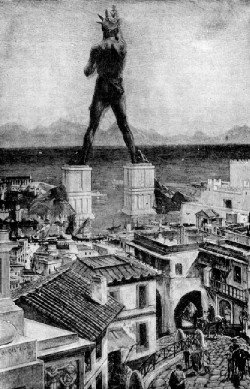 The Colossus of Rhodes was a giant statue of the god Helios, erected on the Greek island of Rhodes by Chares of Lindos between 292 BC and 280 BC. It was roughly the same size as the Statue of Liberty in New York, although it stood on a lower platform. It was one of the Seven Wonders of the World.
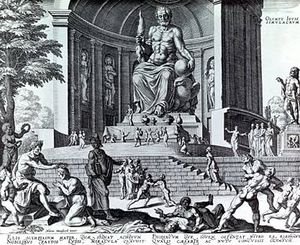 The Statue of Zeus at Olympia is one of the classical Seven Wonders of the Ancient World. It was carved by the famed Classical sculptor Phidias (5th century BC) circa 435 BC in Olympia, Greece.
The seated statue occupied the whole width of the aisle of the temple that was built to house it. According to a contemporary source, it was about 12 metres (~37 feet) tall. "It seems that if Zeus were to stand up," the geographer Strabo noted early in the 1st century BC, "he would unroof the temple." Zeus was carved from ivory (technically the ivory was soaked in a liquid that made it softer, so it was probably both carved and shaped as necessary) then covered with gold plating (thus chryselephantine) and was seated on a magnificent throne of cedarwood, inlaid with ivory, gold, ebony, and precious stones. In Zeus' right hand there was a small statue of Nike, the goddess of victory, and in his left hand, a shining sceptre on which an eagle perched [1] Visitors like the Roman general Aemilius Paulus, the victor over Macedon, were moved to awe by the godlike majesty and splendor that Phidias had captured. Hanging Gardens Of Babylon
According to accounts, the gardens were built to cheer up Nebuchadnezzar's homesick wife, Amyitis. Amyitis, daughter of the king of the Medes, was married to Nebuchadnezzar to create an alliance between the nations. The land she came from, though, was green, rugged and mountainous, and she found the flat, sun-baked terrain of the Mesopotamia (a region of southwest Asia) depressing. The king decided to recreate her homeland by building an artificial mountain with rooftop gardens.
The Hanging Gardens probably did not really "hang" in the sense of being suspended from cables or ropes. The name comes from an inexact translation of the Greek word kremastos or the Latin word pensilis, which means not just "hanging” but "overhanging," as in the case of a terrace or balcony.
The Greek geographer Strabo, who described the gardens in the first century BC, wrote, "It consists of vaulted terraces raised one above another, and resting upon cube-shaped pillars. These are hollow and filled with earth to allow trees of the largest size to be planted. The pillars, vaults, and terraces are constructed of baked brick and asphalt."
 The Great Pyramid of Giza is the oldest and last remaining of the Seven Wonders of the World. Egyptologists generally agree the pyramid was constructed over a 20 year period concluding around 2560 BC. It is generally believed the Great Pyramid was built as the tomb of Fourth dynasty Egyptian pharoah Khufu (Cheops), after whom it is sometimes called Khufu's Pyramid or the Pyramid of Khufu. Khufu's vizier, Hemiunu, is credited as the architect of the Great Pyramid.
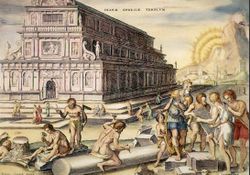 The Temple of Artemis was located in the ancient city of Ephesus, about 50 km south from the modern port city of Izmir, in Turkey. Like the other wonders, Antipater chose the temple for his list not because of its beauty or size, but rather because it rested near the border of the Greek world. This inspired a sense of mystery and awe for the Greeks, and emphasized Alexander the Great's vast empire.The Temple was designed and constructed around 550 BC by the Cretan architect Chersiphron and his son Metagenes. This early construction was built at the expense of Croesus, the wealthy king of Lydia. Marshy ground was selected for the building site as a precaution against future earthquakes, according to Pliny the Elder. The temple became a tourist attraction, visited by merchants, kings, and sightseers, many of whom paid homage to Artemis in the form of jewelry and various goods. Its splendor also attracted many worshippers, many of whom formed the cult of Artemis.
 The Pharos of Alexandria was a tower built in the 3rd century BC on the island of Pharos in Alexandria, Egypt to serve as that port's landmark, and later, lighthouse.
With a height variously estimated at between 117 and 134 metres (440ft) it was the tallest man-made structure on Earth for many centuries, and was identified as one of the Seven Wonders of the World by Antipater of Sidon.
It ceased operating and was largely destroyed as a result of two earthquakes in the 14th century AD; some of its remains were found on the floor of Alexandria's Eastern Harbour by divers in 1994. More of the remains have subsequently been revealed by satellite imaging.
Constructed from large blocks of light-coloured stone, the tower was made up of three stages: a lower square section with a central core, a middle octagonal section, and, at the top, a circular section. At its apex was positioned a mirror which reflected sunlight during the day; a fire was lit at night. Extant Roman coins struck by the Alexandrian mint show that a statue of a triton was positioned on each of the building's 4 corners. A statue of Poseidon stood atop the tower during the Roman period.
The design of minarets in many early Islamic mosques many centuries later followed a similar three-stage design to that of the Pharos, attesting to the building's broader architectural influence.
Legends tell of the light from the Pharos being used to burn enemy ships before they could reach shore, however this is highly unlikely due to the relatively poor quality of optics and reflective technology in the time period in which the building existed. Only slightly less impressive - and probably more accurate - is the claim that the light from the lighthouse could be seen up to 35 miles (56 km) from shore
so that was the 7 ancient wonders of the world.....not eiffel tower and statue of liberty or what shit that my frens, myself or u would have thought...whahaha my personal favourite is the statue of zeus...its so freaking big...whats yours?



.jpg)